JEE Main Physics Preparation requires a clear understanding of topics from both Class 11 and Class 12. The syllabus covers topics, including Mechanics, Electrostatics, Current Electricity, Optics, Modern Physics, and Thermodynamics. Based on historical trends, three major units dominate the question paper.
Mechanics accounts for roughly 30% to 35% of the Physics section, while Electrostatics and Current Electricity together contribute around 20% to 25%. Optics and Modern Physics combined make up another 20% to 25% of the section.
- The Physics section consists of 25 questions in total, with 20 MCQs and 5 NAT questions. It carries 100 marks out of the total 300 marks in the exam.
- Each correct MCQ answer awards 4 marks, while an incorrect answer results in a penalty of 1 mark.
This article covers everything you need for a complete and structured JEE Main Physics Preparation plan, including important topics with weightage, the best books to follow, PYQ and study material.
JEE Main Physics Preparation Tips 2027
A strong preparation plan is built on the right habits and a clear direction. Here are the most effective tips to guide your JEE Main Physics Preparation throughout the year.
Start with the Syllabus and Exam Pattern
Before opening any textbook, download the official JEE Mains Physics Syllabus PDF from the NTA website. Understanding the full scope of the chapter-wise syllabus helps you decide where to spend more time. Students who know the exam pattern from the beginning can plan their studies with far more precision
Build Concepts with NCERT First
NCERT Class 11 and 12 Physics textbooks are the starting point for every serious JEE aspirant. Before moving to advanced reference books, make sure every concept in the NCERT is clear. Many questions come directly from the NCERT theory, especially in topics such as Modern Physics, Thermodynamics, and Semiconductor Devices.
Give Extra Time to High-weightage Topics
Not all chapters carry equal importance. Mechanics alone covers close to one-third of the Physics section. Electrostatics, Current Electricity, Optics, and Modern Physics together account for nearly half the paper. A smart preparation plan dedicates more hours to these chapters and ensures that the fundamentals within them are extremely strong before moving to less frequent topics.
Solve Problems Every Day
Physics is not a subject you can learn by reading alone. Daily problem-solving is essential. Start with solved examples from your textbook, then move on to exercises, and gradually increase the difficulty by working through reference books. Numerical-based questions make up around 60 to 65% of the Physics paper, so your ability to solve problems quickly and accurately directly affects your score.
Revise Formulas and Derivations Regularly
Physics involves a large number of formulas, laws, and derivations. It is easy to forget them if you are not revising frequently. Maintain a dedicated formula notebook for each chapter and review it at least twice a week.
Take Timed Mock Tests
Time management is one of the biggest challenges in the actual exam. Students who have practised under timed conditions consistently perform better. Take at least one full-length Physics mock test every week during the final two months of preparation. Use the NTA JEE Main mock test portal at jeemain.nta.nic.in for the most authentic practice experience.
Analyse Your Mistakes After Every Test
Taking a test is only half the work. The other half is reviewing what went wrong. After every mock test or practice session, go through your incorrect answers carefully. Identify whether the mistake was due to a weak concept, a calculation error, or time pressure. This analysis helps you target specific weaknesses and improve systematically over time.
Download JEE Main Physics PYQPs
JEE Main Physics Preparation 2027: Month-wise Plan
A structured month-wise plan ensures you cover the full syllabus without rushing at the end. The table below provides a realistic schedule for JEE Main 2027 aspirants.
| Month | Topics to Cover | Additional Activity |
| June | Kinematics, Laws of Motion, Work and Energy | NCERT reading and basic numericals |
| July | Rotational Motion, Gravitation, Properties of Matter | H.C. Verma exercises |
| August | Thermodynamics, Oscillations, Waves | Chapter-wise PYQ solving |
| September | Electrostatics, Current Electricity | DC Pandey practice problems |
| October | Magnetic Effects, EMI, AC Circuits, Electromagnetic Waves | Topic-wise mock tests |
| November | Optics (Ray and Wave), Modern Physics, Semiconductors | Full-length mock test every week |
| December | Complete syllabus revision, formula sheets | Previous year papers (2019 to 2026) |
| January | Weak topic revision, exam strategy | NTA mock tests daily |
JEE Main Physics Preparation Books
Choosing the right JEE Prep books is one of the most important decisions in your preparation. The books listed below are trusted by toppers, recommended by coaching institutes, and aligned with the JEE Main 2027 exam pattern. Each book serves a specific purpose, and using them in the right combination makes a significant difference.
| Book | Author | Purpose |
| Concepts of Physics Vol. 1 and 2 | H.C. Verma | Best for building deep conceptual understanding and practising a wide variety of problems |
| Understanding Physics Series | D.C. Pandey (Arihant) | Excellent chapter-wise coverage with JEE-focused problems and detailed solutions |
| NCERT Physics Class 11 and 12 | NCERT | Foundation for theory and direct exam questions, especially in Modern Physics |
| Problems in General Physics | I.E. Irodov | Advanced problem-solving for students targeting top ranks |
| Fundamentals of Physics | Halliday, Resnick and Walker | Strong conceptual reference, especially for Mechanics and Electrostatics |
| 40 Days Physics for JEE Main | S.B. Mathur (Arihant) | Ideal for last-minute revision with topic summaries and practice questions |
JEE Physics Important Topics 2027
Understanding which topics carry the most weight is central to smart preparation. The table below shows the approximate weightage of each unit based on trends from JEE Main previous year question papers.
| Unit | Chapters Covered | Approx. Weightage |
| Mechanics | Kinematics, Newton’s Laws, Work and Energy, Rotational Motion, Gravitation | 30 to 35% |
| Electrostatics and Current Electricity | Electric Field, Potential, Capacitors, Ohm’s Law, Circuits | 20 to 25% |
| Optics | Ray Optics, Wave Optics, YDSE, Diffraction | 10 to 12% |
| Modern Physics | Photoelectric Effect, Bohr Model, Nuclei, Radioactivity | 8 to 10% |
| Thermodynamics and KTG | Laws of Thermodynamics, Processes, Kinetic Theory | 8 to 10% |
| Electromagnetic Induction and AC | Faraday’s Law, Lenz’s Law, Transformers, LCR Circuits | 6 to 8% |
| Waves and SHM | Simple Harmonic Motion, Sound Waves, Doppler Effect | 5 to 7% |
| Magnetic Effects | Biot-Savart Law, Ampere’s Law, Moving Charges | 5 to 6% |
| Semiconductors and Communication | p-n Junction, Logic Gates, Communication Basics | 3 to 5% |
Most Important Chapters for JEE Main Physics
For JEE Main Physics Preparation 2027, the following topics are absolutely must-do:
Mechanics (30–35% Weightage)
Mechanics is the backbone of the JEE Main important topics in Physics. It includes:
- Kinematics (1D and 2D motion, projectile motion)
- Newton’s Laws of Motion, friction, and circular motion
- Work, Energy, and Power
- Rotational Motion, Moment of Inertia, Angular Momentum
- Gravitation, Kepler’s Laws, escape velocity, orbital speed
Every year, 7–9 questions come from Mechanics alone. Strong JEE Main Physics Preparation means mastering this unit first.
Electrostatics & Current Electricity (20–25% Weightage)
This unit is extremely important in JEE Main Physics Preparation. Key topics include:
- Coulomb’s Law, Electric Field, Potential, Gauss’s Law
- Capacitors — series/parallel combinations, energy stored
- Kirchhoff’s Laws, Wheatstone Bridge, potentiometer
- Ohm’s Law, resistance, and power in circuits
Optics & Modern Physics (20–25% Combined Weightage)
Optics and Modern Physics together form another high-weightage unit. Important sub-topics:
- Refraction, Total Internal Reflection, lenses and mirrors
- Wave optics, Young’s Double Slit Experiment, diffraction
- Photoelectric Effect, de Broglie wavelength
- Bohr’s Model, energy levels, nuclear reactions, radioactivity
Thermodynamics & SHM
Do not ignore Thermodynamics and Simple Harmonic Motion in your JEE Main Physics Preparation. The first law, isothermal/adiabatic processes, and SHM equations appear almost every year.
JEE Main Physics Question Papers
Solving JEE Main Physics PYQ is one of the most recommended strategies by toppers and coaching experts. Previous Year Questions help you understand what NTA actually asks, which JEE physics important topics recur every year, and how questions are framed for both MCQ and NAT formats.
JEE Main Physics NTA Study Material
NTA offers several free and official resources that are directly useful for JEE Main Physics Preparation. Many students are unaware of these tools or do not use them fully. The sections below explain what is available and how to use each resource effectively.
NTA Content-Based Lectures (IIT-PAL)
NTA has developed a series of content-based video lectures for JEE Main Physics in collaboration with IIT professors and subject experts. These lectures are completely free and are available on the NTA portal as well as the NTA YouTube channel.
- Access at: nta.ac.in/lecturesContent
- YouTube Channel: youtube.com/NationalTestingAgency
- Coverage: Complete JEE Main Physics syllabus, topic by topic
- Best used for: Understanding difficult concepts and clearing doubts in complex chapters.
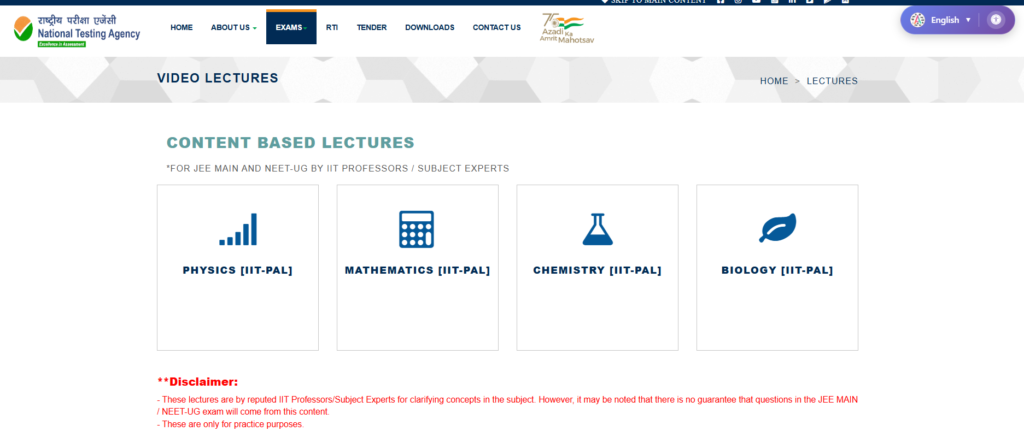
These lectures are especially useful for students who do not have access to classroom coaching and are preparing independently. They cover topics from both Class 11 and Class 12 and are structured to align with the JEE Main syllabus.
Please note that NTA has clarified that these lectures are for concept building only and do not guarantee that questions will appear directly from this content.
NTA Official Mock Tests
NTA provides free full-length mock tests on the official JEE Main portal. These tests replicate the exact Computer-Based Test format, including the interface, timer, and question types. Taking these tests is the best way to experience the actual exam environment before the real exam.
Study Material by Byju’s & Aakash
The table below provides the chapter-wise study material for JEE Main Physics Preparation by Byju’s & Aakash:
Frequently Asked Questions (FAQs)
Start with the NCERT Class 11 and 12 Physics books to build a strong foundation. Then move to H.C. Verma for concept clarity and problem-solving. Create a chapter-wise study plan based on the syllabus, solve PYQs, and take regular mock tests.
The best JEE Main Physics Preparation Books are NCERT (Class 11 & 12), H.C. Verma’s Concepts of Physics (Vol. 1 & 2), D.C. Pandey’s Understanding Physics series, and I.E. Irodov for advanced practice. Also, use 40 Days Physics for JEE Main by Arihant for last-minute revision. Advanced students can also refer to I.E. Irodov for challenging numericals.
NTA provides free content-based lectures by IIT professors at nta.ac.in/lecturesContent and on the NTA YouTube channel. Several education platforms also offer JEE Mains Physics short notes PDF downloads that can be useful for quick revision.
The JEE Physics Important Topics with the highest weightage are: Mechanics (30–35%), Electrostatics and Current Electricity (20–25%), and Optics and Modern Physics (20–25% combined). Together, these three units cover about 70% of the Physics section. The remaining marks are distributed across Thermodynamics, Waves, Electromagnetic Induction, and other chapters.
NCERT is necessary but not sufficient on its own. It covers the theory clearly and serves as the source of many direct questions in chapters such as Modern Physics and Semiconductor Devices. However, the level of numerical problems in JEE Main requires practice beyond the NCERT. You should supplement it with H.C. Verma and D.C. Pandey for problem practice and use PYQs to understand the exact style and difficulty of JEE Main questions.
NTA provides free official mock tests at jeemain.nta.nic.in. These tests are designed to replicate the exact CBT format of the actual exam. You can attempt them from any computer or device with internet access. These mock tests are one of the most valuable free resources available for final-stage preparation.
The JEE Mains Physics Syllabus covers topics from Class 11 and Class 12 Physics. Class 11 topics include Mechanics, Thermodynamics, Waves, Oscillations, and Kinematics. Class 12 topics include Electrostatics, Current Electricity, Optics, Modern Physics, Electromagnetic Induction, and Semiconductor Devices.